
Carolina Puccoon (Lithospermum caroliniense)
This summer, when walking through dunes toward Lake Michigan, you may bump into … Carolina puccoon—a charming little perennial in the borage family. It is characterized by bright yellow-orange flowers on top of erect, stout stems with stiff hair and alternate, lanceolate leaves.
Carolina puccoon grows to a height of 6 inches to 2.5 feet, often forming clumps with multiple stems arising from a central taproot. The light green stems are usually unbranched below the inflorescence.
Blooming from May to early August, the flowers are arranged in a flat, spiral pattern at the tops of the stems. Each flower is about an inch across with a narrow tubular throat and five flaring, rounded yellow-orange lobes. The flowering branches elongate as the plant matures, with flowers open at the tip and fruit forming below. Each fertilized flower develops up to four hard shiny white nutlets. This plant reproduces primarily by seed.
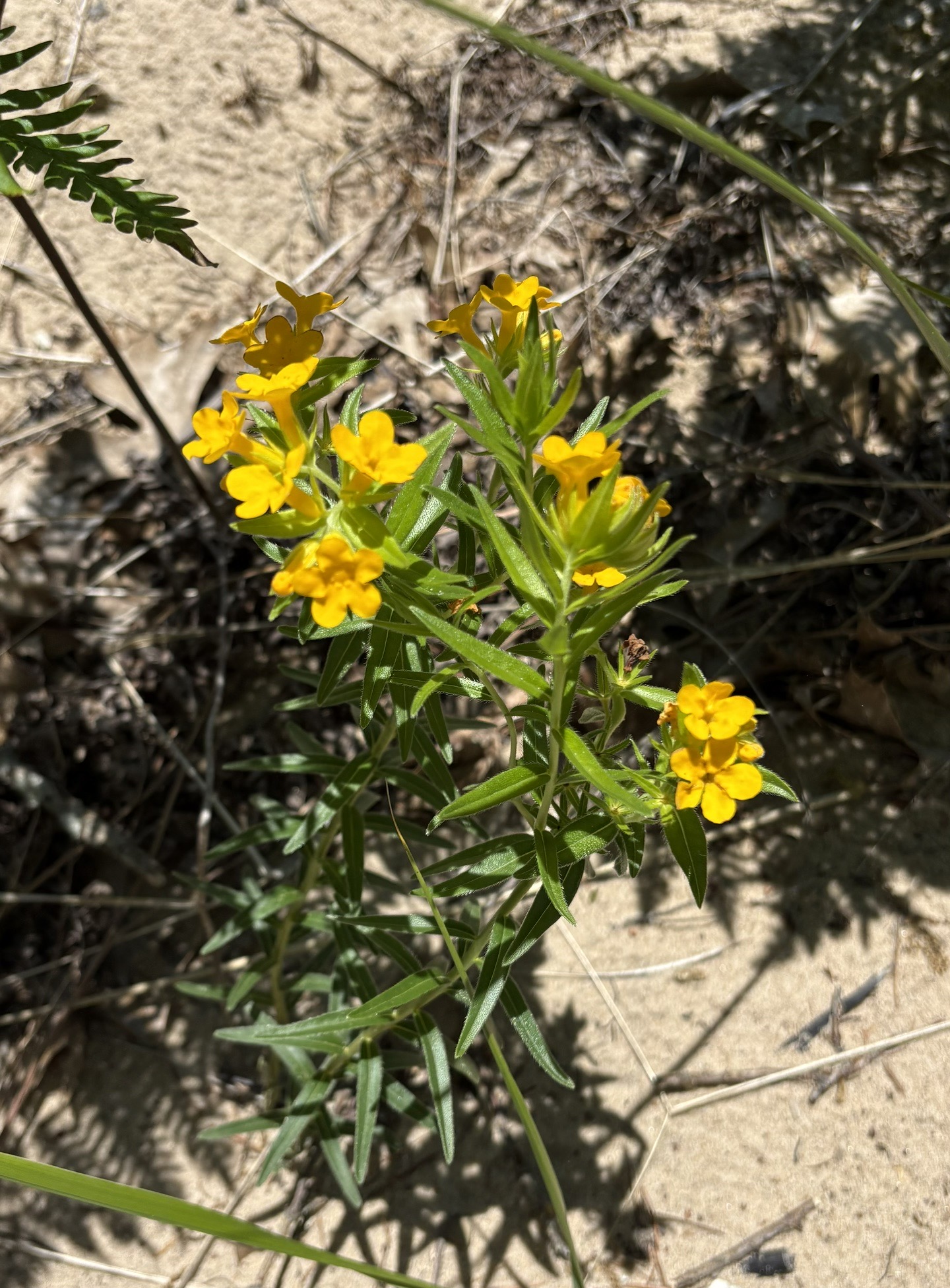
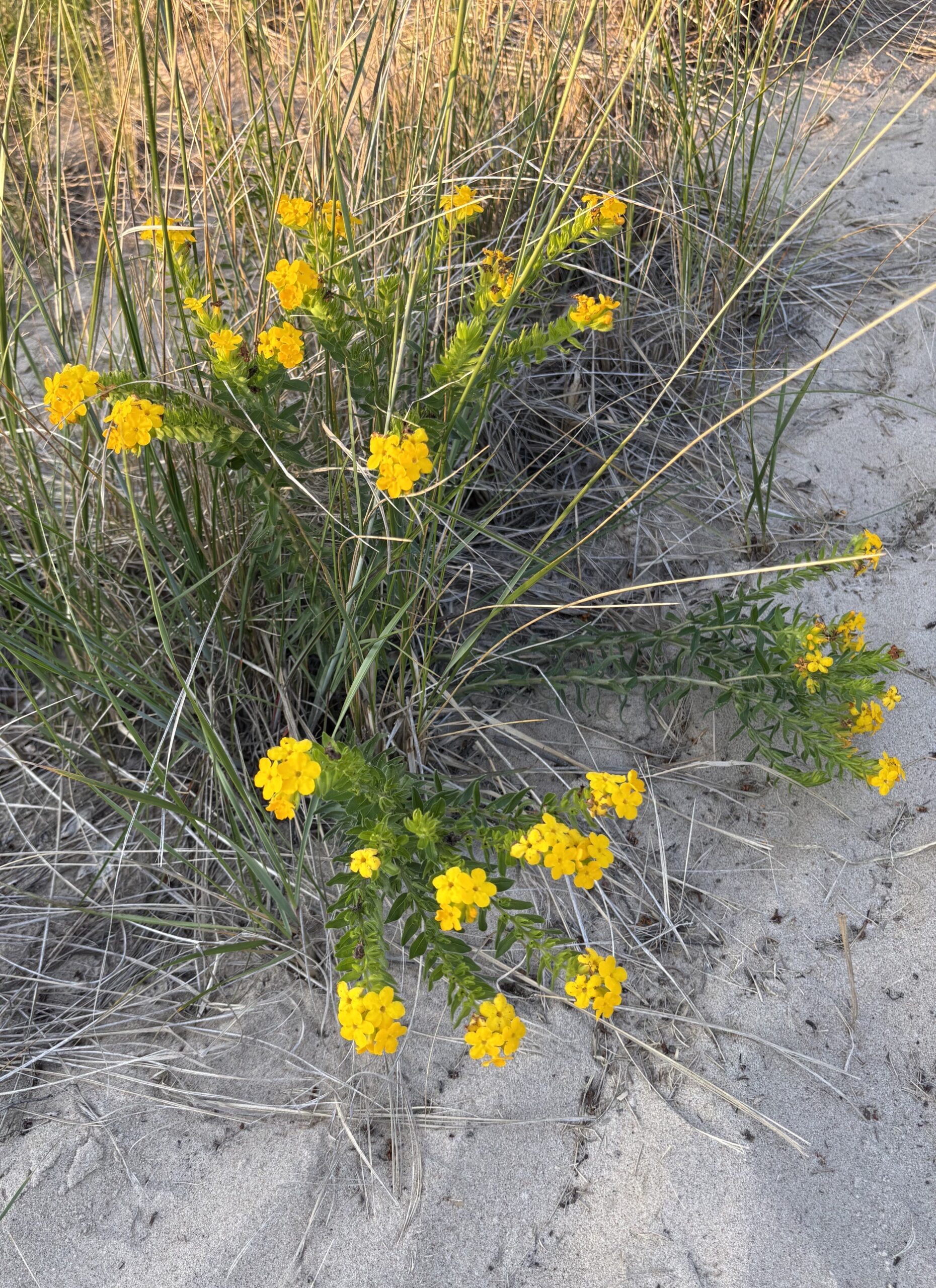
The plant’s deep root system makes it well adapted to dry conditions. The taproots are internally reddish-purple in color—and were once valued by indigenous peoples for the red dye that can be extracted from them. In fact, the name “puccoon” comes from the Powhatan word “poughkone” meaning “dye.”
Carolina puccoon is native to most of the central U.S. and parts of our eastern states. It thrives in dry to dry-mesic sandy or rocky soils, favoring habitats such as dunes, prairies, open woodlands or savannas, and sandy barrens. It can benefit from disturbances such as fire or dynamic dunes with shifting sands—which reduce competition from woody plants and tall grasses.
This plant provides nectar for bees and butterflies, including the Karner blue (a federally endangered species) and the Hobomok skipper. The stems and roots host certain specialized beetle and moth larvae. It is occasionally browsed by deer.
Carolina puccoon is a delightful addition to pollinator and rock gardens, prairie restorations, or dry naturalized landscapes. The plant adapts to many soil types, if the soil is well-aerated and has good drainage. Waterlogged conditions can lead to root rot. Slow to develop at first, this plant prefers full sun to part shade and a pH range that is neutral to slightly acidic. Once established, this plant requires minimal care and is drought tolerant.
Note: Carolina puccoon is easily mistaken for Hoary puccoon (Lithospermum canescens) which is a similar but smaller plant—with smaller, typically oranger flowers, and softer hairs on the stems. Hoary puccoon also blooms earlier in the season (late spring) and is often found in areas with more vegetative cover such as low prairie grasses and sedges.