Natives to Know: Yellow Trout Lily, Erythronium americanum
Compiled by Joyce Tuharsky, Wild Ones Member
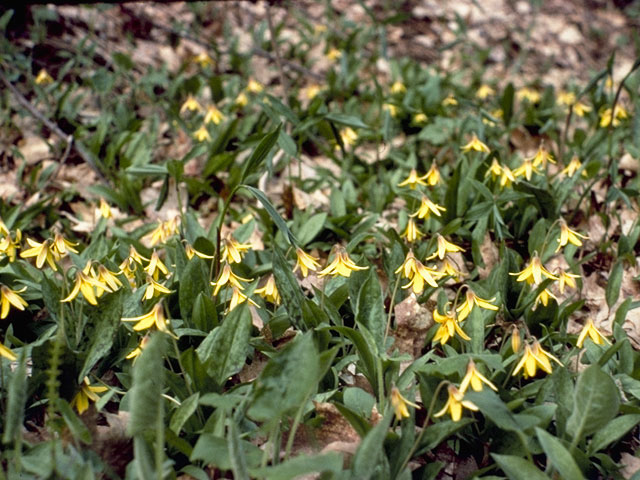
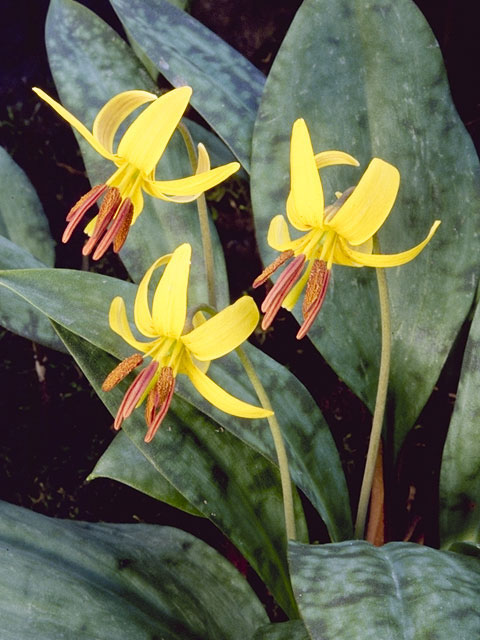
When Yellow trout lilies start blooming on the forest floor, it is a quiet sign that spring has begun. These flowers are cherished for their lily-like shape with 6 bright yellow tepals that curve elegantly back, exposing 6 prominent brown stamens and 3 yellow stigmas. The flowers nod downward, about 6 inches high, atop an erect stalk, and close each night. (Tepals are flower parts that cannot be easily classified as either petals or sepals.)
The flowers are later replaced by ½-inch, obovoid seed capsules, which eventually divide into 3 parts to release their seeds. The seeds are distributed, in part, by ants, which are attracted to the elaiosomes (fleshy structures rich in lipids and proteins) attached to the seeds.
The leaves of Yellow trout lilies are 2–9 inches long, up to 2 inches across, lanceolate in shape, with smooth edges. The upper surfaces of the leaves are uniquely marbled with pale green and bronze colors that resemble the skin of brook trout—thus the common name. This marbled pattern is thought to disguise the leaves from herbivores who have poor color vision. Indeed, deer rarely eat the foliage of this plant.
The root system consists of a corm with fibrous roots beneath. Yellow trout lilies also produce stolons, which extend just below the leaf litter, creating clonal offshoots and leading to the formation of colonies. Individual plants often do not flower until year 4 or later. Therefore, in a given colony, only about 5% of plants flower at a time!
Native to the eastern half of North America from Nova Scotia south to Louisiana, Yellow trout lilies are typically found in moist shaded woods or along streams under deciduous trees. Its pollen and nectar are an important source of spring food for many bees, including Mason bees, Andrenid bees, miner bees, and bumblebees.
One species of native miner bee, Andrena erythronii, is a specialist pollinator for Yellow trout lilies. Like all mining bees, this species is a solitary bee that digs a tunnel in the ground in which to lay its eggs. Before the arrival of honeybees in North America, native mining bees were the primary pollinators of blueberries, apples, and other early blooming crops—and could help fill that role again if honeybees continue to decline.
In a garden, Yellow trout lilies can be used to replace non-native daffodils or crocuses. They prefer dappled sunlight and moist, loamy soil with leaf litter or other decaying organic matter. They do not do well with drought. Be patient, as Yellow trout lilies take some years to bloom. Once established, they will spread slowly and can live a long time. Some colonies are known to have lived 200–300 years! It is humbling to know that a native wildflower you plant today can last for generations.